8 Consumption Smoothing
Objectives
- Understand concept of (and motivation for) consumption smoothing
- Study consumption and trade balance responses of open economy to income shocks
- Temporary
- Permanent
8.1 Consumption: Budget Constraint and Preferences
We first solve the consumption problem. Solving the problem involves two components: a budget constraint (what can we afford) and preferences (what do we want).
The budget constraint takes on the form of the present value condition. Rather than having a constraint between apples and oranges, this constraint is between consumption today (apples today), consumption tomorrow (apples tomorrow), and so on.
The present value condition states that the present value of income must equal the present value of consumption. This is the condition that arises when we can borrow or save in a bank at interest rate \(r^*\), but we cannot ‘scam’ the bank.
The second condition is the consumption smoothing condition. We need it because the present value condition is not enough: it gives a menu of different options, but we don’t know which consumption path we prefer (will choose).
The consumption smoothing condition says that we will choose a flat path of consumption because we dislike variance (ups and downs) in our consumption.
8.2 Temporary Shock
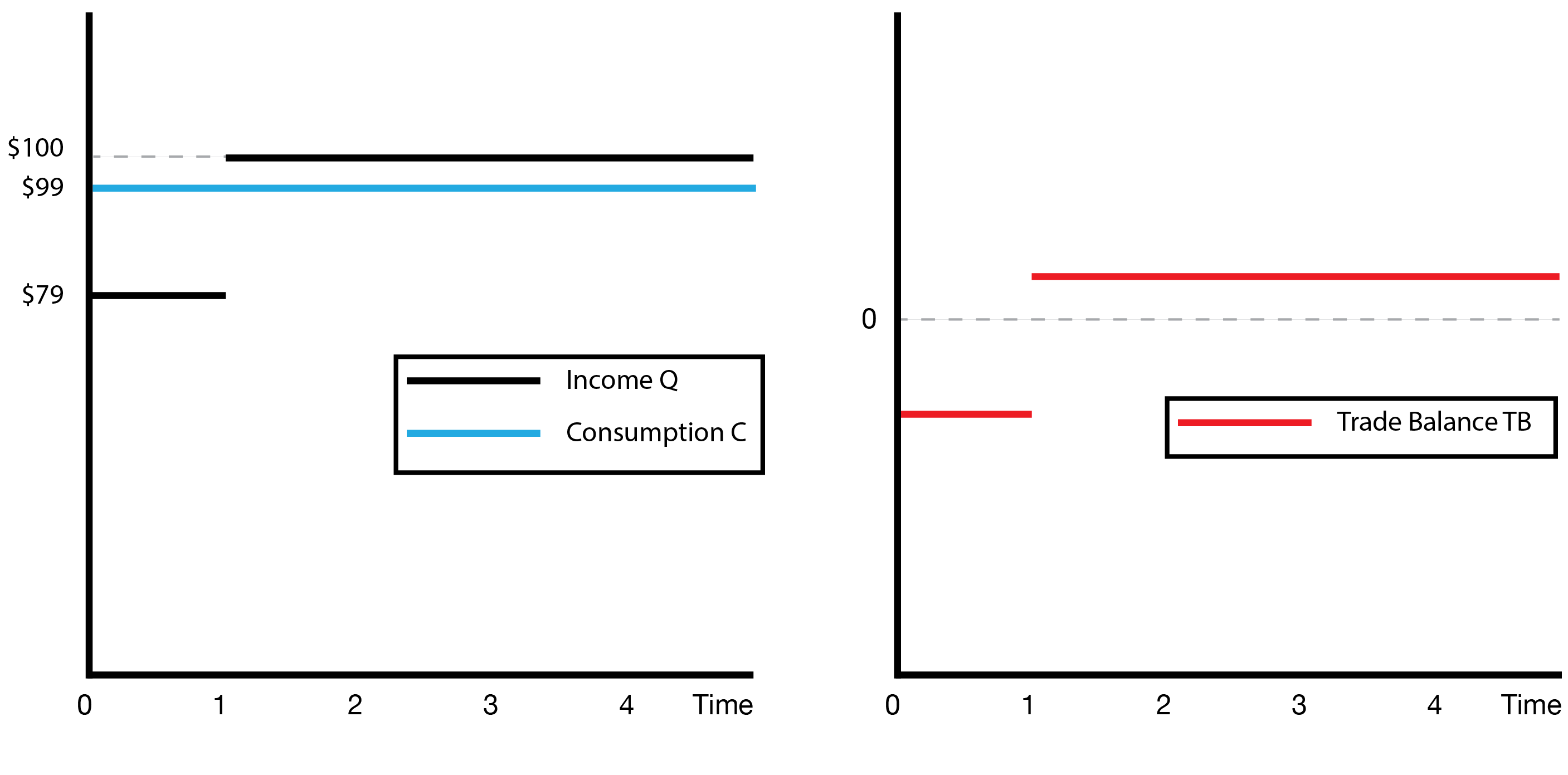
We now consider the responses to a temporary decline in income. In this case, income temporarily declines and then reverts to its original level.
The path of consumption differs from income through the trade balance. Initially, consumption declines by a small amount, but not as much as income. This is because we borrow through the trade balance to smooth consumption. In the next period, income returns to its original level, but consumption is slightly lower than income.
The trade balance displays a large initial deficit, followed by a small permanent surplus. The initial deficit captures the ‘loan’ that Home takes out from abroad to maintain their consumption in the face of the temporary income decline. Once income returns to its original level, Home pays back the loan, which is captured by the small surplus in the trade balance.
8.3 Permanent Shock
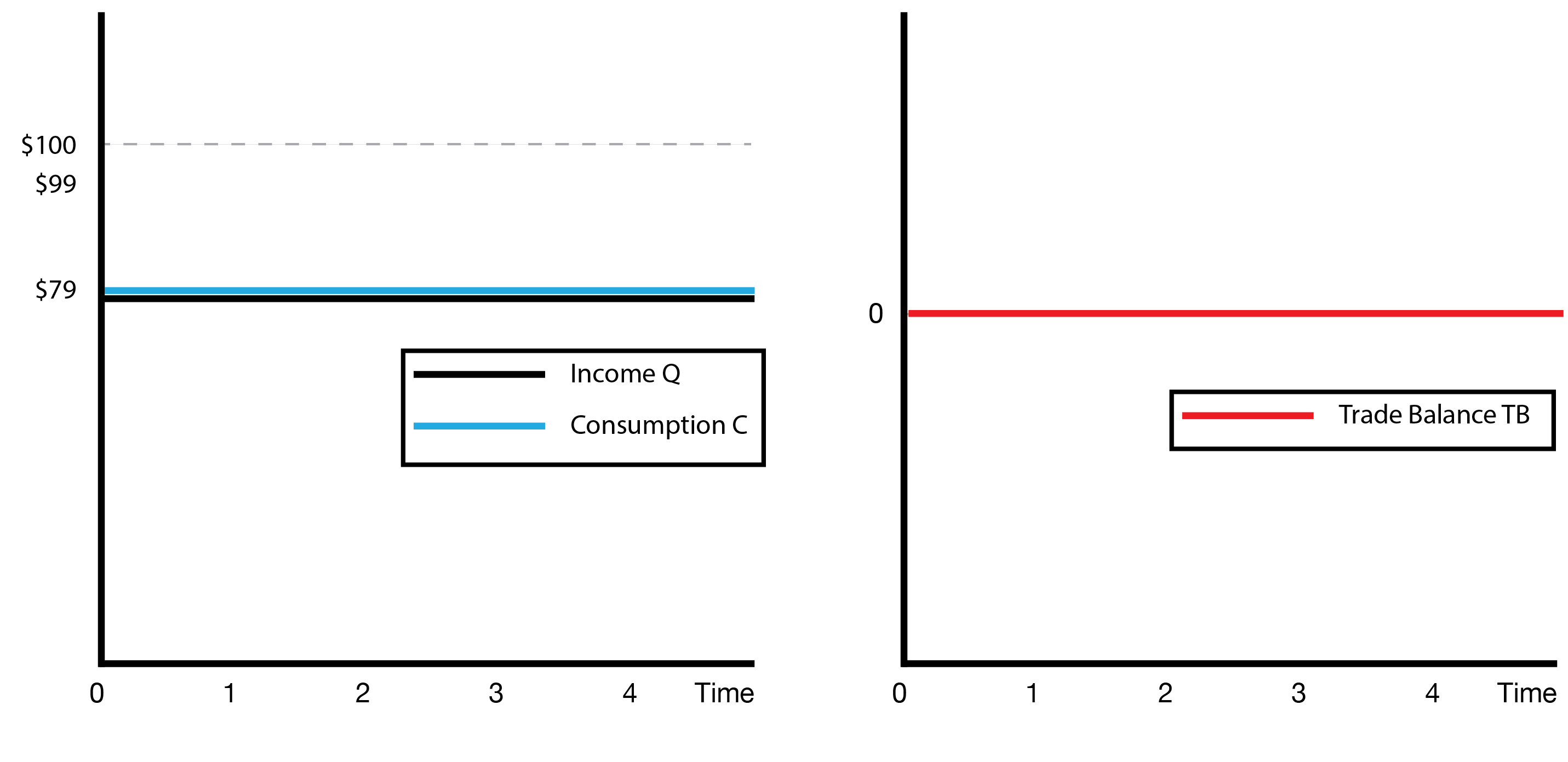
We now consider the responses to a permanent decline in income. In this case, income permanently declines from its original value. Consumption must again satisfy both the present value and consumption smoothing conditions. As a result, consumption goes down by the same level as income and stays there.
The trade balance does not respond to a permanent shock because the consumer does not borrow or save in order to smooth consumption. Intuitively, there is no way to ‘get around’ a permanent shock.
8.4 Summary
The following table summarizes the consumption and trade balance responses to temporary and permanent income shocks.
| Income Shock | Consumption Response | Trade Balance Response |
|---|---|---|
| Temporary Increase | Small Permanent Increase | Large surplus followed by small deficit |
| Temporary Decrease | Small Permanent Decrease | Large deficit followed by small surplus |
| Permanent Increase | Permanent Increase | No response |
| Permanent Decrease | Permanent Decrease | No response |
8.5 Conclusion
- This lecture introduces the concept of consumption smoothing in international finance
- We show an open economy can more successfully smooth temporary shocks using its trade balance (borrowing/saving)
- We find that permanent shocks are more damaging in that we cannot ‘consumption smooth’ them